Most dental practice acquisitions that go wrong don’t fail because of bad intentions. They fail because of financial blind spots — numbers that weren’t scrutinized closely enough, deal structures that weren’t fully understood, or tax consequences that weren’t anticipated until it was too late to plan around them.
Buying or selling a dental practice is likely the largest financial transaction of your career. The stakes are high enough that what you don’t know can cost you significantly more than what you do know.
Duckett Ladd is a CPA and dental practice advisory firm that has guided dentists through acquisitions and transitions at every scale. This guide covers the financial layer of that process from start to finish. Legal and HR considerations are real and important, but this guide focuses exclusively on the financial decisions, structures, and due diligence steps that determine whether a deal works in your favor.
The Four Financial Stages of a Dental Practice Acquisition
Whether you’re buying or selling, every dental practice transaction moves through four financial stages:
Stage 1: Valuation — Understanding what the practice is actually worth before anyone names a price.
Stage 2: Financial Due Diligence — Verifying that what’s being represented is accurate and complete.
Stage 3: Deal Structure — Deciding how the transaction is structured and what that means for both parties’ tax positions.
Stage 4: Post-Closing Financial Setup — Getting the new entity, accounting systems, and first-year tax strategy in place immediately after closing.
Each stage has its own financial risks and its own checklist. The sections below walk through all four.
Stage 1: Practice Valuation — Understanding What the Practice Is Actually Worth
Valuation is where most buyers take their first financial risk. They accept the seller’s asking price as the starting point for negotiation when it should be the starting point for scrutiny.
How dental practices are valued
Most dental practices are valued using one of three approaches: EBITDA multiples (earnings before interest, taxes, depreciation, and amortization), revenue multiples based on gross collections, or a collections-based formula tied to the trailing 12 months. Each method produces a different number, and the method that favors the seller is often the one they’ll present.
Specialty practices (oral surgery, orthodontics, periodontics) typically command higher EBITDA multiples than general dentistry. DSO-backed acquisitions may apply different valuation frameworks altogether. Understanding which model applies to the practice you’re evaluating is step one.
What drives valuation up or down
- Patient retention rate and active patient count
- Payer mix (fee-for-service vs. heavy insurance dependency)
- Age and condition of clinical equipment
- Lease terms and location stability
- Provider concentration risk (does production drop significantly if the selling dentist leaves?)
- Revenue trend over the past three years (growing, flat, or declining)
A practice with strong collections but declining patient retention is not worth the same as one with equivalent collections and a stable or growing base. A dental-specific advisor knows how to read these signals.
Why asking price and fair market value often differ
Sellers are emotionally attached to their practices and often price based on what they need for retirement, not what the market will bear or what the financials support. A seller-provided valuation prepared without independent verification is a starting point for your own analysis, not a conclusion.
Red flags in seller-provided valuations
- Add-backs that are excessive or poorly documented
- Production figures presented without corresponding collection data
- Equipment listed at book value that would require near-term replacement
- Revenue spikes in the final year that aren’t explained by patient or production growth
Before making an offer, have an independent dental CPA review the valuation methodology. This is not optional.
For a broader look at the buying process, see our buying a dental practice checklist.
Stage 2: Financial Due Diligence Checklist
Due diligence is where the real financial picture emerges. This is the stage most buyers rush through because they’re excited about the deal. It’s also where the most expensive mistakes are made.
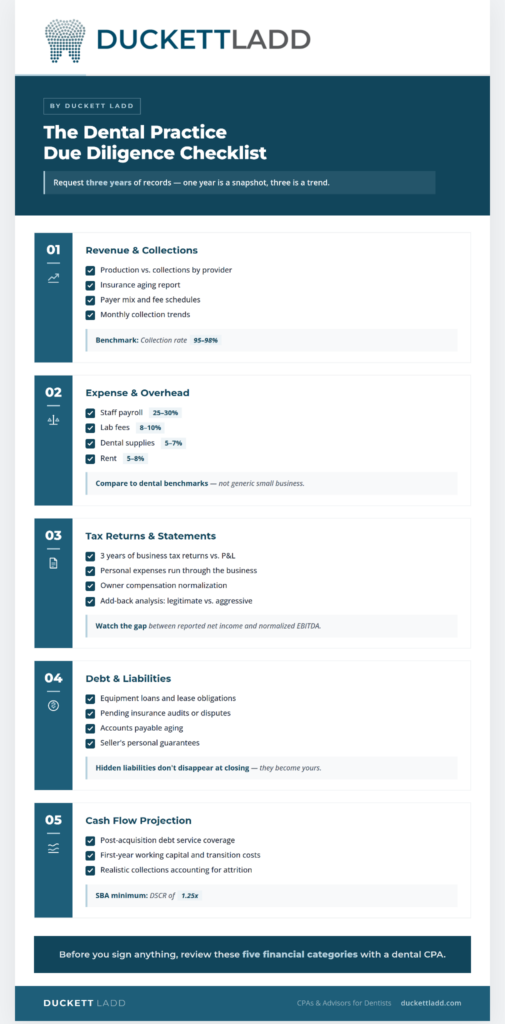
Request a minimum of three years of financial records. One year is a snapshot. Three years is a trend.
Revenue and Collections Review
- Three years of production vs. collection reports, broken down by provider and procedure
- Insurance aging report (how old is the outstanding receivable, and how collectible is it?)
- Fee schedules by payer, including any contracted insurance discounts
- Payer mix breakdown (what percentage of revenue comes from each insurance plan vs. fee-for-service)
- Month-by-month collection trends to identify seasonal patterns or unexplained gaps
A practice with strong production but a collection rate below 95-98% has a revenue management problem that doesn’t disappear when ownership changes.
Expense and Overhead Analysis
- Staff payroll as a percentage of collections (industry benchmark: 25-30%)
- Lab fees as a percentage of production (benchmark: 8-10% for general dentistry)
- Dental supply costs (benchmark: 5-7% of collections)
- Rent as a percentage of collections (benchmark: typically 5-8% depending on market)
- Any unusual or non-recurring expenses that inflate or deflate the true overhead picture
Compare every category against dental industry benchmarks, not generic small business benchmarks. A dental CPA knows what normal looks like for a practice at this revenue level and specialty type.
Tax Return and Financial Statement Review
- Three years of business tax returns (compare to the P&L provided by the seller)
- Identification of personal expenses run through the business (owner cell phone, vehicle, travel)
- Owner compensation normalization (what does the practice actually earn after a market-rate replacement dentist salary is accounted for?)
- Add-back analysis: which adjustments are legitimate and which are aggressive
The gap between a practice’s reported net income and its normalized EBITDA is where the real negotiation lives. Understanding what’s actually in the P&L is non-negotiable before you agree to any price.
Debt and Liability Review
- Outstanding equipment loans and lease obligations (will these transfer or be paid off at closing?)
- Any deferred compensation arrangements with employees
- Pending or unresolved insurance audits or disputes
- Accounts payable aging (are vendors current or significantly past due?)
- Any personal guarantees the seller has made in connection with the business
Liabilities that aren’t surfaced in due diligence don’t disappear at closing. They become your problem.
Cash Flow Projection
- Debt service coverage ratio post-acquisition (can the practice service the acquisition loan out of operating cash flow, with adequate cushion?)
- First-year liquidity needs, including working capital, any planned equipment upgrades, and transition costs
- Realistic collection projections in the transition period, accounting for potential patient attrition
SBA lenders will require a debt service coverage ratio of at least 1.25x. Knowing your number before you apply saves time and shapes your offer.
The Dental Practice Due Diligence Checklist
Stage 3: Deal Structure and Tax Implications
How a deal is structured affects the tax outcome for both buyer and seller. This is one of the most consequential financial decisions in the entire process, and it’s made before closing.
Asset sale vs. stock sale
The large majority of dental practice acquisitions are structured as asset sales. In an asset sale, the buyer purchases specific assets of the practice (equipment, patient records, goodwill, the practice name) rather than the legal entity itself. For the buyer, this is generally favorable because it allows a step-up in basis on acquired assets, enabling depreciation deductions from day one.
For the seller, a stock sale can produce more favorable capital gains treatment. Expect this to be a negotiating point, particularly with larger or more complex transactions.
Allocation of purchase price
In an asset sale, the total purchase price must be allocated across asset categories: tangible assets (equipment, supplies), intangible assets (goodwill, patient relationships), and covenants such as a non-compete agreement. Each category carries a different tax treatment for both buyer and seller.
- Goodwill is taxed as a capital gain for the seller but amortized over 15 years by the buyer
- Equipment is taxed as ordinary income for the seller (depreciation recapture) but depreciable more quickly by the buyer
- Non-compete payments are ordinary income for the seller and deductible by the buyer
Because buyer and seller interests on allocation are often opposed, this is an area where having an experienced dental CPA on your side matters. The allocation isn’t just an accounting entry. It’s a negotiation with real dollar consequences.
SBA 7(a) financing and deal structure
If you’re financing the acquisition through an SBA 7(a) loan (the most common path for dental acquisitions), the deal structure must meet SBA eligibility requirements. Seller financing can be used alongside SBA debt in certain configurations. How goodwill is allocated and how the business is valued affects loan eligibility and terms.
Installment sales and earn-out structures
An installment sale, where the seller receives payments over multiple years rather than a lump sum at closing, can be a tax planning tool for sellers managing capital gains exposure. An earn-out structure ties a portion of the purchase price to future practice performance, reducing the buyer’s upfront risk in situations where revenue trends are uncertain. Both structures have financial and tax implications that require careful modeling before they’re agreed to.
Stage 4: Post-Closing Financial Setup
Closing is not the finish line. What happens in the 90 days after closing determines whether the financial foundation of your new practice is solid or reactive.
Setting up the new entity structure
If you’re acquiring as a new entity, entity formation, banking, and tax elections need to be in place before the first payroll runs. S-Corp elections, payroll setup, and state registration requirements all have timing constraints. Missing them creates problems that take time and money to unwind.
Transitioning accounting, payroll, and bookkeeping
The seller’s accounting systems are their systems, not yours. From day one, your practice needs its own chart of accounts, payroll process, and financial reporting structure. Inheriting the seller’s bookkeeping without reviewing and resetting it is a common source of first-year financial confusion.
First-year tax planning
The year you acquire a practice is one of the most important tax planning years of your career. Equipment depreciation elections, retirement plan setup, owner compensation structure, and entity-level tax decisions all need to be addressed before year-end. Many first-time buyers don’t engage their CPA on these questions until tax season. By then, most of the planning opportunities have already passed.
When to engage a fractional CFO
For acquisitions that involve complex financing, a second location, or an existing team being absorbed into a new entity, a fractional CFO can provide the ongoing financial oversight that a CPA relationship alone doesn’t cover. More detail on that role is covered in our fractional CFO for dental practices guide.
The Seller’s Financial Checklist
If you’re on the other side of the table, the same financial rigor applies. The difference is timing. Sellers who prepare two to three years before listing get meaningfully better outcomes than those who start when they’re already ready to leave.
Getting financials acquisition-ready 2-3 years out
Buyers and their advisors will scrutinize your last three years of financials. That means the work of cleaning up your books needs to start well before you’re ready to list. Inconsistent bookkeeping, commingled personal and business expenses, and undocumented add-backs all reduce perceived practice value and invite skepticism from buyers’ advisors.
Cleaning up the P&L
- Remove or clearly document all personal expenses running through the business
- Normalize owner compensation to reflect a market-rate salary for a replacement dentist
- Resolve any outstanding vendor disputes or aging payables
- Ensure your collection rate and overhead ratios reflect the practice at its operational best
A clean, benchmarked P&L tells a story. An unexplained one creates doubt.
Pre-sale tax planning
The tax consequences of a dental practice sale can be significant. Capital gains on goodwill, ordinary income on equipment (due to depreciation recapture), and the timing of when proceeds are received all affect what you net after the transaction.
An installment sale structure may allow you to spread recognition of gains across multiple tax years, reducing the impact of a large one-time event. If you’re planning to retire or significantly reduce income after the sale, the timing of when you close relative to your income level in that year matters.
Pre-sale tax planning is not something to address after you’ve accepted an offer. The structure of the deal, and much of the tax outcome, is negotiated before signing.
Understanding your net proceeds
Sellers often focus on the gross purchase price. The number that matters is what you actually deposit after taxes, broker fees, CPA and advisory fees, and any seller financing you’re carrying. Modeling your net proceeds under different deal structures and tax scenarios is a critical step that Duckett Ladd walks through with every seller client.
For practices evaluating long-term transition planning, see our dental practice succession planning resources.
Why Dental-Specific Financial Advisory Matters in an Acquisition
Dental practice acquisitions are not generic business transactions. The valuation methods are different. The benchmarks are different. The financing structures, payer mix dynamics, and post-closing patient retention risks are all specific to dentistry.
A general business advisor or CPA may understand M&A mechanics. But they don’t know that a collection rate below 95% in a fee-for-service practice is a meaningful red flag. They may not recognize that a spike in associate payroll in the final year before listing can indicate the seller was reducing their own clinical production in anticipation of the sale. They won’t benchmark lab fees, supply costs, and overhead ratios against dental industry data because they don’t have it.
Duckett Ladd’s M&A advisory work for dental practices includes:
- Independent practice valuation review
- Financial due diligence support for buyers
- Pre-sale financial preparation for sellers
- Deal structure and tax impact modeling
- Post-closing entity and accounting setup
- Ongoing fractional CFO support during the transition period
We work alongside your legal team and lender, not in place of them. Our focus is the financial layer, which is where most of the value is either created or lost.
For an overview of our M&A advisory services, visit our dental practice M&A services page.
Frequently Asked Questions: Dental Practice M&A
What does a dental practice M&A advisor do?
A dental M&A advisor provides financial guidance throughout the acquisition or sale process, including practice valuation review, financial due diligence, deal structure analysis, and post-closing setup. A dental-specific advisor brings industry benchmarks and context that a general business advisor doesn’t have, which changes the quality of the analysis at every stage.
How long does a dental practice acquisition take?
From letter of intent to closing, most dental acquisitions take 60 to 120 days, depending on financing complexity, due diligence findings, and how quickly both parties can respond to information requests. SBA-financed deals often take longer due to lender processing timelines. Pre-closing preparation by both parties significantly affects how smoothly the process moves.
What is a fair multiple for a dental practice?
General dentistry practices typically sell at 60-80% of annual collections or 3-5x EBITDA, though both ranges vary based on location, specialty, payer mix, equipment condition, and growth trajectory. Specialty practices often command higher multiples. DSO-driven acquisitions may use different frameworks. The right multiple for any specific practice depends on a full financial analysis, not a general rule of thumb.
What is dental practice financial due diligence?
Financial due diligence is the process of independently verifying the financial information provided by the seller, including tax returns, P&L statements, production and collection reports, payroll records, and outstanding liabilities. It’s the step that separates what a practice appears to be worth from what it’s actually worth. Duckett Ladd performs financial due diligence as a core part of our buyer advisory process.
What are the tax implications of selling a dental practice?
Tax implications depend on deal structure, how the purchase price is allocated, and the seller’s overall income position. Goodwill is typically taxed at long-term capital gains rates. Equipment is subject to depreciation recapture at ordinary income rates. Installment sale structures can spread the tax impact across multiple years. Pre-sale tax planning with a dental CPA is essential to understanding your actual net proceeds before you accept any offer.
Talk to a Duckett Ladd Advisor Before You Sign Anything
Dental practice acquisitions reward preparation and punish assumptions. The financial decisions made before closing shape the tax outcome, the financing terms, and the first-year operating reality of your new practice. The decisions made after closing determine how quickly you stabilize and grow.
Duckett Ladd is a CPA and business advisory firm serving dental practices nationwide. Our M&A advisory work covers both sides of the transaction, from the first valuation review through post-closing financial setup. We’ve guided dentists through acquisitions at every scale, and we know what the numbers should look like, and when they don’t.
If you’re evaluating a purchase or preparing to list your practice, start the conversation now, before the letter of intent is on the table.
Talk to a Duckett Ladd Advisor
Duckett Ladd provides CPA and business advisory services to dental practices nationwide. This content is for informational purposes only and does not constitute legal or financial advice specific to your situation. Consult a qualified CPA and legal counsel before entering into any acquisition or sale agreement.